

Views: 0 Author: Site Editor Publish Time: 2026-11-02 Origin: Site


For years, alternative proteins have been the sustainability story of pet food. Insects, fermented biomass, cultivated cells and novel plant concentrates all promise a lower-impact protein supply — but commercial survival still comes down to one unglamorous question: will the pet actually eat it?
A peer-reviewed study published on 23 September 2026 suggests that, for at least one fermentation-derived protein, the answer is now yes. In a controlled in-home feeding trial, both dogs and cats preferred kibble containing 10% microbial protein over a conventional animal-protein formula. The result does not settle the debate over novel proteins — but it moves the conversation from "can pets be persuaded?" to "how do we scale this responsibly?"
This article breaks down the trial, the broader commercial momentum behind fermentation-derived proteins, and what the 2026 inflection point means for pet food formulators and ingredient buyers.
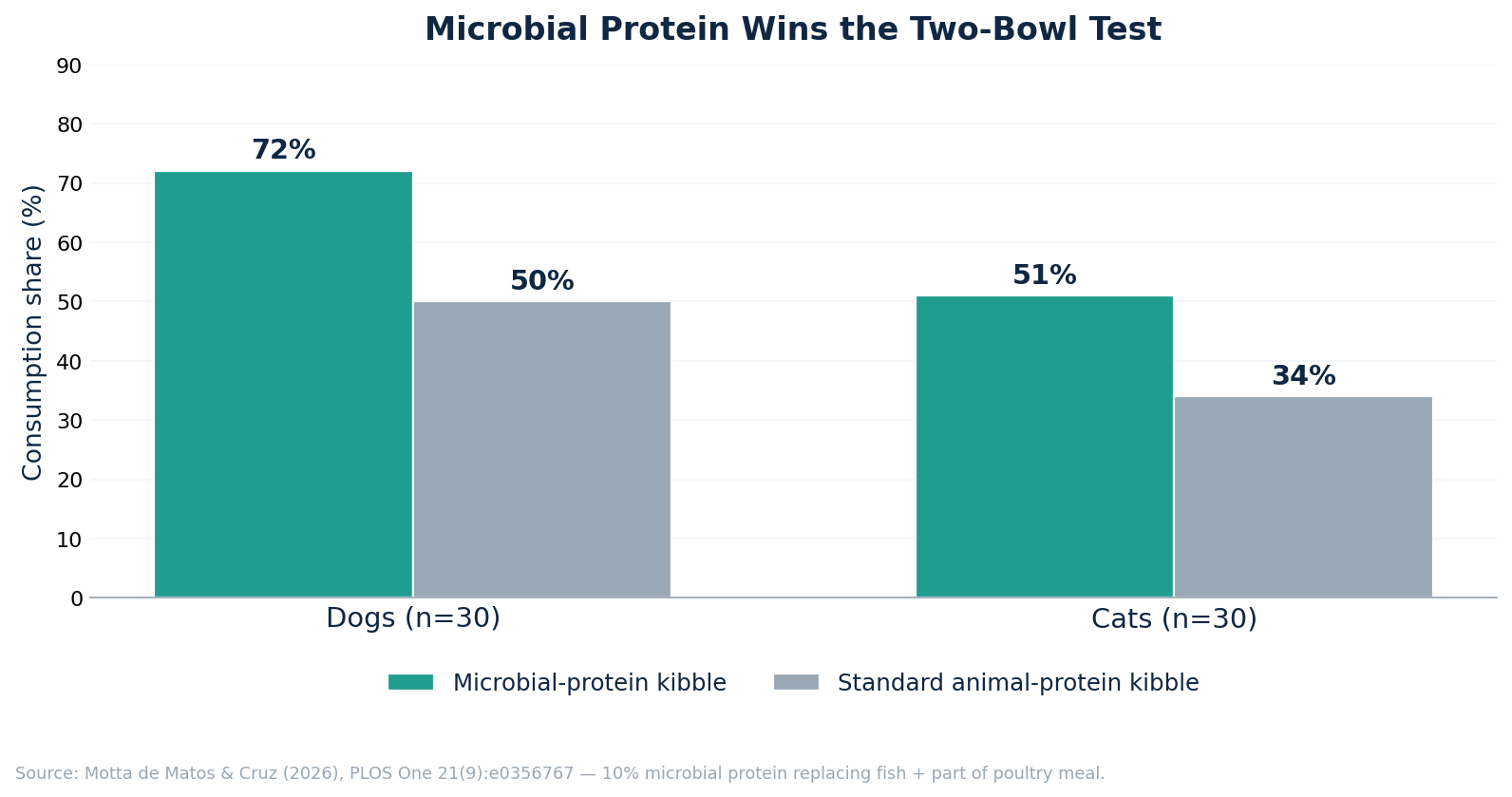
Researchers at MicroHarvest — a European company that produces protein through fermentation and has named pet food as its first commercial market — published the findings in PLOS One (Motta de Matos & Cruz, 2026). The trial was an in-home, two-bowl preference test: owners offered 30 dogs and 30 cats two nutritionally equivalent extruded diets for four consecutive meals over two days.
Sample: 30 dogs and 30 cats, tested in their own homes.
Inclusion: 10% microbial protein, replacing fish meal and part of the poultry meal in the control formula.
Dog consumption: 72% of the microbial-protein kibble vs 50% of the standard kibble.
Cat consumption: 51% of the microbial-protein kibble vs 34% of the standard kibble.
First choice: both dogs and cats more often approached and ate from the microbial-protein bowl first.
Independence: the in-home trial and statistics were designed and run by Sense Test; Eurofins Food Testing Portugal handled analytical characterisation. MicroHarvest funded the work.
The authors are careful about scope. The study measured short-term food preference, not long-term acceptance, digestibility or health outcomes. "Demonstrating nutritional quality is important," they wrote, "but ultimately the food also needs to be something dogs and cats choose to eat." That sentence captures why this result matters: palatability has been the single hardest gate for alternative proteins — especially for cats, where food neophobia can derail even nutritionally sound formulas.
The MicroHarvest result is the most visible data point, but it sits inside a broader 2026 commercial trend: fermentation-derived proteins moving from pilot lines into real product development.
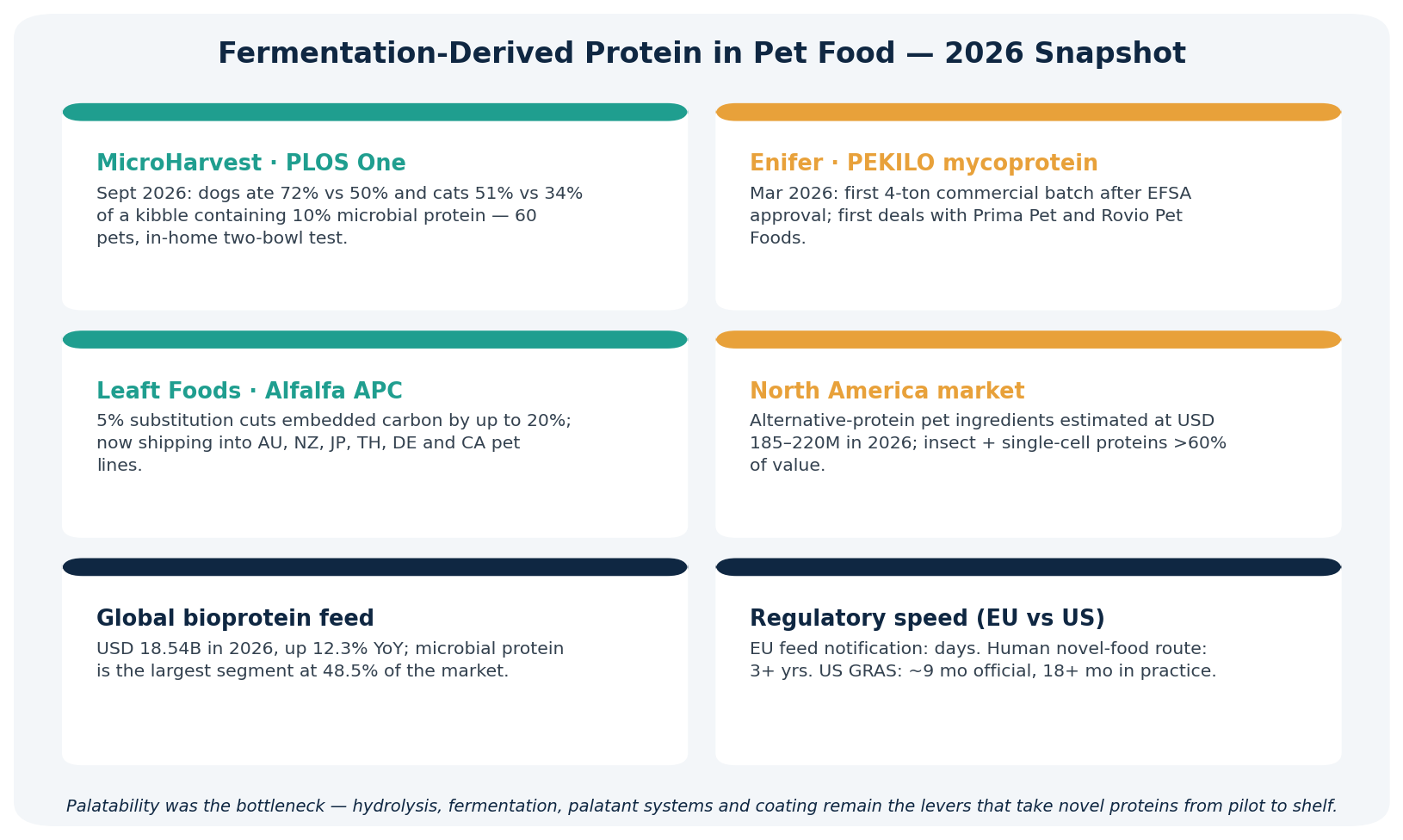
Enifer (Finland): after securing EFSA approval for its PEKILO® mycoprotein in 2024, the company produced its first commercial batch in March 2026 — a 4-ton run it described as "the first substantial volumes available for commercial pet food product development." It signed deals with Prima Pet (cat and dog food) and Rovio Pet Foods (a semi-moist dog treat), and has raised €36M plus a €12M EU NextGenerationEU grant.
Leaft Foods (New Zealand): the alfalfa-protein specialist expanded into pet nutrition with Alfalfa Protein Concentrate (APC). The company says substituting APC for beef at just 5% of a recipe can cut embedded carbon by up to 20%, and it is shipping through a US distribution partnership with Meateor, with products already in Australia, New Zealand, Japan, Thailand, Germany and Canada.
Market scale: the North American alternative-proteins-for-pets ingredient market is estimated at USD 185–220 million in 2026, with insect and single-cell proteins together accounting for over 60% of value. Globally, the bioprotein feed market is projected at USD 18.54 billion in 2026, up 12.3% year on year, with microbial protein the largest segment at 48.5%.
The pattern is consistent across regions: premium and super-premium brands are leading adoption, while cost parity with conventional meals remains the gating factor for mass-market lines.
Sustainability alone does not sell a bowl that sits half-eaten. A lower carbon footprint is irrelevant in practice if the animal rejects the food — which is exactly why palatability data, even from a small study, gets outsized attention.
Prior work on fermentation-derived ingredients was promising but limited. A 2024 Frontiers pilot in dogs found greenhouse-gas-derived fermented protein was well accepted and well tolerated over a short feeding period. Earlier open-access work on dried yeast in extruded dog and cat diets found acceptable or improved palatability in dogs, while calling for more data on digestibility and dose-response. The 2026 MicroHarvest trial adds a stronger signal — but it is still ingredient-specific, short-term, and leaves open questions about long-term acceptance and the optimal inclusion window.
For R&D and procurement teams evaluating novel proteins, four takeaways stand out:
In the study it replaced roughly 10% of the formula's protein. That is enough to contribute a sustainability narrative and a sensory signal without forcing a wholesale re-architecture of the recipe. Wholesale swaps should wait for longer-term acceptance and digestibility data.
Fermented proteins bring their own sensory signature. Nucleotides and free amino acids can deliver umami that pets find attractive, but off-notes may still need masking — especially in cats. The right hydrolysed protein ingredients and a calibrated palatant system remain the levers that move a novel protein from pilot to shelf.
Even a well-formulated diet fails if the correction does not reach the kibble surface. Run a two-bowl baseline test against the conventional product the new formula replaces, then titrate palatant inclusion and confirm coating adhesion and shelf-life stability.
Novel proteins depend on stable, certifiable feedstock. That intersects directly with a March 2026 warning from FEDIAF: competition from subsidised biofuels and biogas is pulling Category 3 animal by-products — the same streams many hydrolysed proteins are built from — toward energy recovery. Coherent bioeconomy policy matters to ingredient availability, not just to sustainability branding.
The speed of commercialisation is partly a regulatory story. In the EU, pet food sits under feed law rather than human "novel food" rules: an ingredient not in the official catalogue can be notified to the industry-managed feed register in days, versus three or more years for the novel-food route. In the US, the GRAS framework applies to both food and feed, with FDA timelines that run about nine months officially but often exceed 18 months in practice. Singapore offers an innovation-friendly path under a year. For manufacturers, that means novel proteins can reach market faster as feed ingredients than as human food — but claims still must be substantiated everywhere.
Labeling is also tightening. Following the EU Green Claims Directive and anti-greenwashing rules, vague terms like "eco-friendly" are increasingly challenged; FEDIAF guidance pushes brands toward specific, evidence-based language and digital QR-code labeling. Expect pet food packs to carry more precise, verifiable sustainability claims through 2026 and beyond.
The 2026 study measured short-term food preference, not long-term safety, digestibility or health outcomes. The authors explicitly call for further research. Safety conclusions should wait for longer feeding and tolerance studies.
At this stage it functions as a partial replacement. In the published trial it made up 10% of the formula. Broader substitution depends on scale-up, cost parity and longer-term acceptance data.
In this trial, yes — both dogs and cats consumed more of the microbial-protein kibble and chose it first. But palatability is ingredient- and formulation-specific, so each substrate still needs its own sensory validation.
It opens a lower-impact protein option for brands under sustainability pressure, while reinforcing that formulation expertise — hydrolysis, fermentation, palatant systems and coating — is what converts a promising ingredient into a product pets finish.
Microbial protein cleared an early and important gate in 2026: pets chose it. That is a meaningful signal for an industry searching for lower-impact proteins, not a market-ready conclusion. The manufacturers who benefit will be those who treat palatability, processing and supply resilience as design inputs rather than afterthoughts.
For suppliers, the lesson is that novel proteins do not remove the need for palatant and hydrolysis expertise — they increase it. If you are developing a fermentation-derived or alternative-protein diet and need to close a palatability or sensory gap, talk to our technical team about hydrolysed-protein bases and customised palatant systems for insect, plant and fermented protein matrices.
Related reading: Alternative Protein in Pet Food: Solving the Palatability Challenge — a technical guide to the hydrolysis, fermentation, palatant and coating levers behind alternative-protein acceptance.
 phoebe@tdtbio.com
 +86-18972222769
 Haowangzhuang Town, Wucheng County, Dezhou City, Shandong Province, China