

Views: 0 Author: Site Editor Publish Time: 2026-10-19 Origin: Site


Alternative proteins are no longer a niche experiment in pet food. Black soldier fly larvae, fermented soybean meal, pea protein and yeast-derived ingredients now appear in commercial diets across Europe, North America and Asia. The environmental case is settled enough that most major brands have at least one alternative-protein SKU in development.
What remains unsettled is the question that decides whether those products survive on shelf: will the pet actually eat it?
For manufacturers, this is where formulation strategy meets commercial reality. A diet that scores well on sustainability metrics but sits half-eaten in the bowl generates returns, complaints and lost retail listings. This article examines why alternative proteins create palatability problems, what the research actually shows, and which practical levers — hydrolysis, fermentation, palatant systems and coating — close the gap.
Conventional pet food relies on poultry, beef and fish tissues whose aroma profiles evolved to match carnivore preference. Dogs and cats recognise these substrates instinctively: the volatile compounds released during rendering and extrusion are familiar signals of nutrient density.
Alternative proteins arrive with a different sensory signature, and the mismatch runs in both directions — some lack the savoury notes pets seek, while others introduce notes they actively reject.
Protein source | Typical palatability issue | What drives it |
|---|---|---|
Pea protein / pea starch | Bitter, low initial attraction — especially in cats | Saponins and phenolic compounds; cats are highly sensitive to bitterness |
Insect meal (BSFL, mealworm) | Variable acceptance; earthy or musty off-notes | Chitin content, lipid oxidation, species-specific volatile profiles |
Fermented soybean meal | Beany notes; inconsistent batch aroma | Residual oligosaccharides, fermentation end-products |
Single-cell / yeast protein | Often acceptable or better — high umami potential | Nucleotides and free amino acids, which cats find highly attractive |
Cultivated or precision-fermented protein | Largely uncharacterised | Limited feeding-trial data at commercial inclusion rates |
The critical insight from recent literature is that ingredient source alone does not determine acceptance. A 2025 review by Scott McGrane at the Waltham Petcare Science Institute concluded that diets containing alternative proteins can achieve good palatability when processed and formulated appropriately — meaning the processing step matters more than the raw material choice itself.
It helps to separate marketing narratives from measured outcomes. The published evidence points to a consistent pattern: processing technique, not protein identity, drives acceptance.
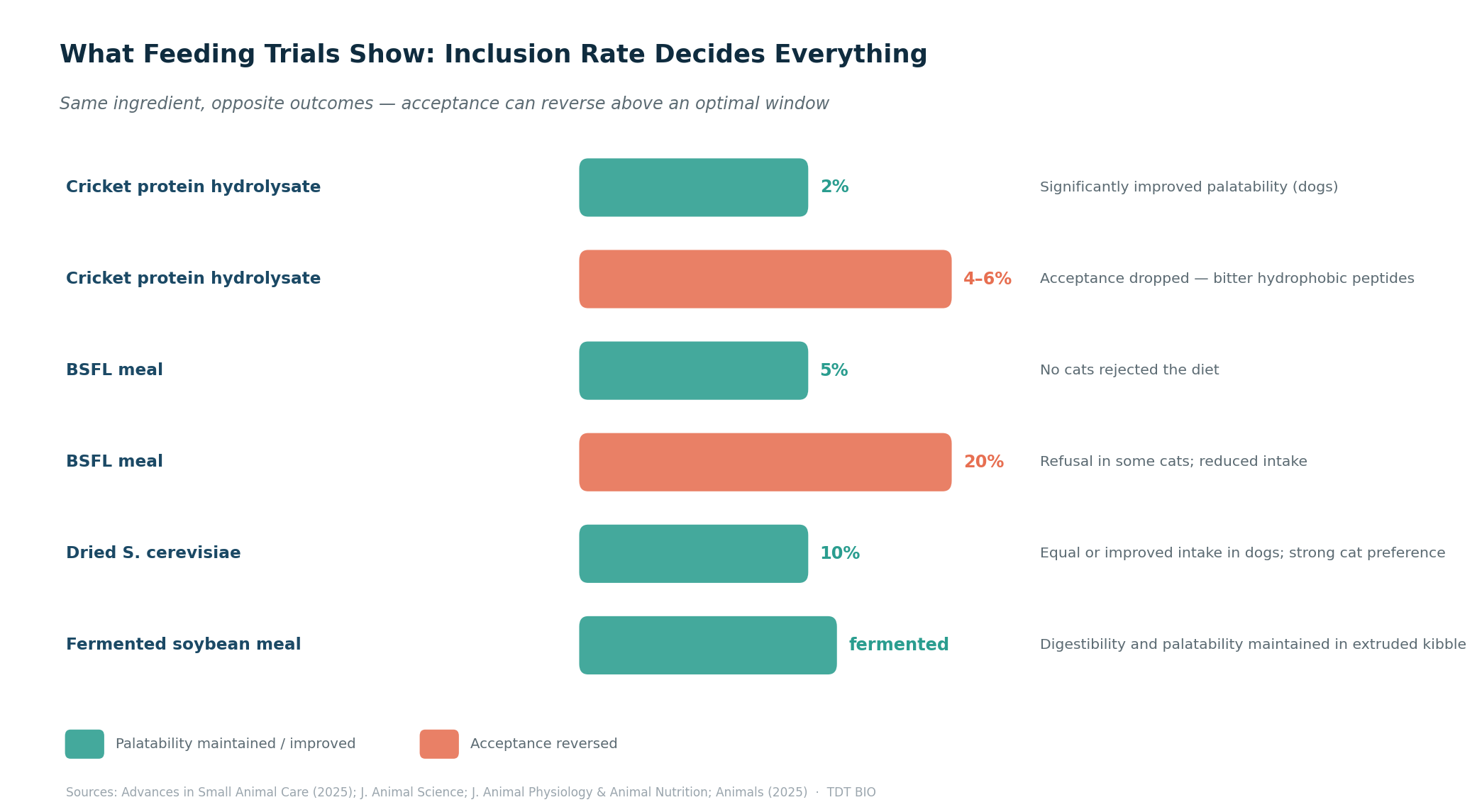
Black soldier fly larvae. Cats readily consumed BSFL-based diets after retort processing while maintaining acceptable nutrient digestibility. Inclusion rate matters: at 5% BSFL meal, no cats rejected the diet, while at 20% one cat refused entirely and others reduced intake.
Cricket protein hydrolysate. A 2% inclusion level significantly improved diet palatability in dogs, but 4% and 6% inclusions reduced acceptance — attributed to bitterness from hydrophobic peptides. More is not better.
Fermented soybean meal. Extruded dog food containing Aspergillus oryzae-fermented soybean meal maintained both digestibility and palatability, demonstrating that plant proteins perform well once fermentation modifies their sensory profile.
Fermented pea starch. Fermentation with Candida utilis improved palatability and food intake in both dogs and cats compared with unfermented pea diets — directly addressing the bitter-note problem.
Yeast (Saccharomyces cerevisiae). Extruded diets with 10% dried yeast showed equal or improved voluntary intake in dogs, and were strongly preferred by cats in two-bowl tests, driven by nucleotides and free amino acids delivering umami.
Two practical conclusions follow. First, cats are the harder audience — their sensitivity to bitterness and their reliance on umami means plant and insect substrates need more deliberate sensory correction. Second, there is an optimal inclusion window for any given alternative protein, and exceeding it can reverse the palatability gain entirely.
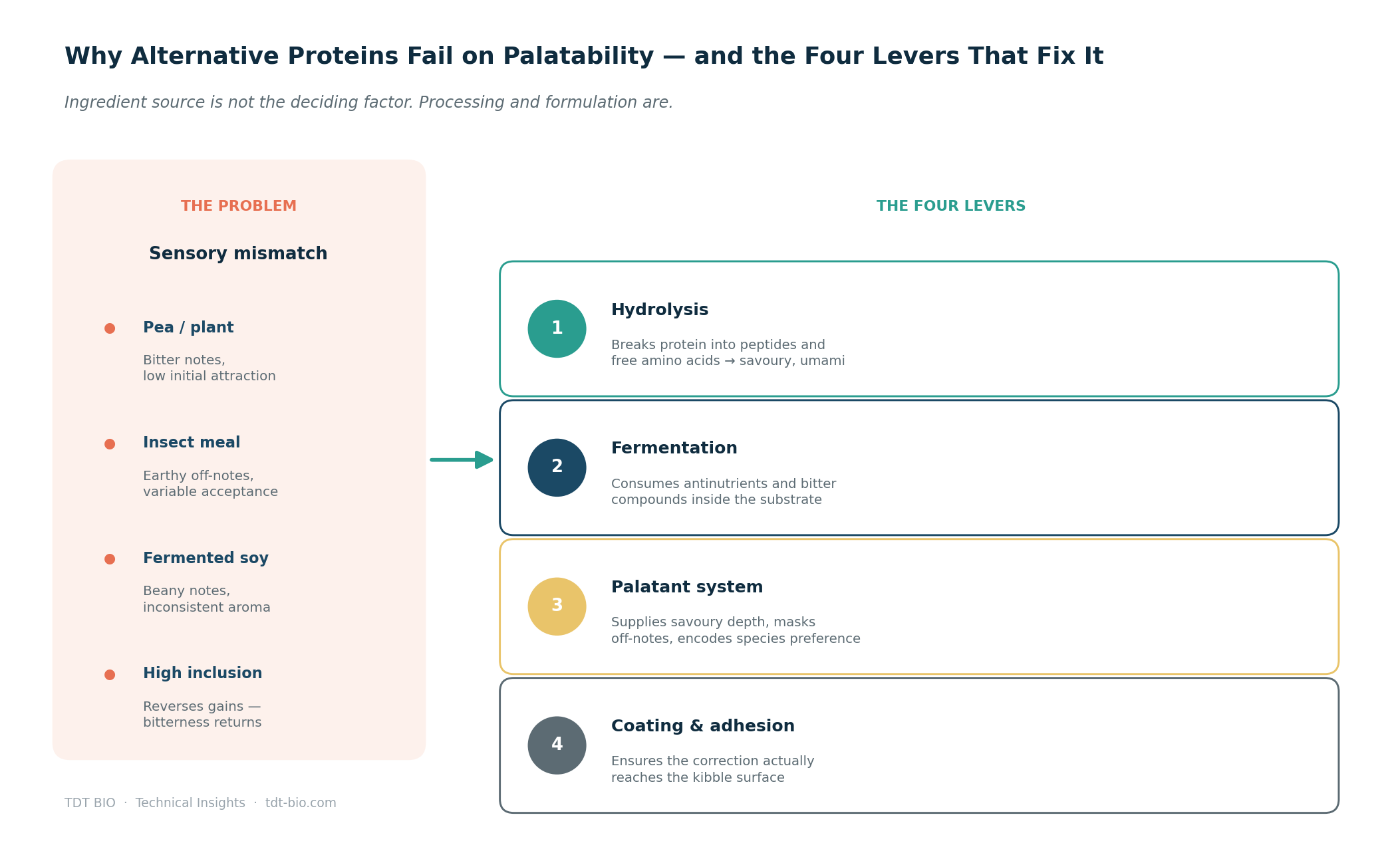
Enzymatic hydrolysis is the single most effective processing route for aligning alternative proteins with carnivore preference. Breaking proteins into peptides and free amino acids generates the savoury, umami-forward profile that dogs and cats seek, while simultaneously improving functional properties such as solubility and emulsification.
Hydrolysed chicken liver, fish protein hydrolysates and chicken liver powder are well-established palatant bases for exactly this reason. When applied to an alternative-protein matrix, they supply the missing savoury signal rather than merely masking an off-note. This is why hydrolysed protein ingredients have become a standard tool in alternative-protein formulation.
Fermentation works from the inside. Microbial action consumes residual sugars and antinutrients, breaks down bitter compounds, and produces aroma-active metabolites. The Candida utilis pea starch results show the effect clearly — the same base ingredient, materially different acceptance, purely from processing.
For manufacturers already using fermented soy or pea ingredients, the palatant strategy should account for what fermentation has already achieved, avoiding redundant correction.
A well-designed palatant for alternative protein does three jobs simultaneously:
Supplies missing savoury depth — through hydrolysed animal protein, yeast extract or reaction flavours
Masks specific off-notes — bitterness from plant proteins, earthy notes from insect meal
Encodes species preference — cat-specific profiles lean harder on umami and marine notes; dog profiles tolerate broader savoury range
Inclusion rate is not a case of "more is better". As the cricket hydrolysate data shows, over-application introduces bitterness of its own. Effective palatant design starts with a sensory baseline of the base diet, then calibrates upward in measured increments.
The best palatant system fails if it does not adhere. Alternative-protein kibbles often present different surface characteristics — porosity, fat absorption, hardness — than conventional formulations.
Practical adjustments include reviewing the fat-to-palatant sequence, verifying kibble surface temperature at coating, and checking that the liquid-to-dry application ratio suits the specific substrate. Adhesion testing after coating will show whether the palatant is reaching the bowl or remaining in the drum.
Rather than reformulating blind, manufacturers can structure the work in five stages:
Establish a sensory baseline. Run a two-bowl test comparing the alternative-protein diet against the conventional product it replaces. Quantify first-choice preference and intake ratio.
Identify the deficit type. Is the problem missing savoury depth, a specific off-note, or low overall intensity? The answer determines whether you need a palatant, a processing change, or both.
Screen processing options before adding palatant. If fermentation or hydrolysis can lift acceptance on its own, you may reduce palatant load and cost.
Titrate palatant inclusion. Test at least three levels including a lower-than-expected one. Data from cricket hydrolysate and BSFL studies both show acceptance can fall at higher inclusions.
Verify adhesion and stability. Confirm the palatant actually reaches the kibble surface, and check performance after accelerated shelf-life storage — aroma loss over time erodes the gain.
Yes, in most published cases. The Waltham review concluded that diets with alternative proteins can achieve good palatability when processed and formulated appropriately. The determining factor is processing — hydrolysis, fermentation, retort conditions — rather than the protein source itself.
Yeast-derived proteins (Saccharomyces cerevisiae) generally perform best with the least intervention, due to naturally high nucleotide and free amino acid content that cats find attractive. Insect and plant proteins typically require more deliberate sensory correction.
There is, and it is lower than many expect. Cricket protein hydrolysate improved palatability at 2% but reduced acceptance at 4% and 6%. For black soldier fly larvae meal, 5% was well accepted while 20% caused refusal in some cats. Inclusion rate should be titrated experimentally rather than maximised.
Yes. Cats are obligate carnivores with heightened sensitivity to bitterness and a strong preference for umami. Plant and insect substrates require more aggressive savoury correction for cats, and palatant systems should be selected on species-specific preference data rather than applied generically.
Alternative proteins do not have an inherent palatability penalty. They have a processing and formulation requirement — and manufacturers who treat that requirement as a design input rather than an afterthought are shipping products that pets finish.
The winning formula in practice is rarely a single ingredient. It is hydrolysis or fermentation to correct the substrate, a calibrated palatant system to restore savoury depth and mask off-notes, and verified adhesion to ensure the correction reaches the bowl.
If you are developing an alternative-protein diet and need to close a palatability gap, talk to our technical team about sensory baseline testing and customised palatant systems for insect, plant and fermented protein matrices.
Related reading: Palatant Inclusion Rate: How Much Is Optimal in Cat Food Formulation — a detailed look at titration methodology for palatant dosage.
 phoebe@tdtbio.com
 +86-18972222769
 Haowangzhuang Town, Wucheng County, Dezhou City, Shandong Province, China