

Views: 0 Author: Site Editor Publish Time: 2026-10-13 Origin: Site


In cat food formulation, palatant inclusion rate is the single variable that most directly determines whether a finished product is accepted or refused. Cats are notoriously neophobic — a cat that rejects a new diet on first exposure may never revisit it. For pet food manufacturers, that first bowl is the entire commercial verdict. Yet palatant dosage is frequently set by habit rather than by data: a formulator inherits a number from a previous product, applies it across every SKU, and never revisits it when the protein base, fat system or process changes.
This guide breaks down realistic palatant inclusion rates for dry and wet cat food, explains how coating technology changes the effective dosage, and offers a practical method for dialling in the optimal level for your own formulation.
Palatant inclusion rate is the percentage of palatant applied to the finished product, expressed by weight of the total diet. The number is deceptively simple, because three different things are often being measured at the same time:
Liquid palatant applied on top — the coating percentage, usually dosed on the surface of extruded kibble or added to a wet food matrix.
Powder palatant blended in — dry palatants added to the meat slurry or premix, often combined with a liquid top-coating for a two-stage system.
Effective palatant load — the fraction that actually reaches the animal's olfactory receptors after processing losses, not the amount that left the dosing pump.
The gap between the third and first definitions is where most formulation failures hide. Heat, moisture and the order of addition can destroy a meaningful share of volatile aroma compounds before the product is ever packed.
Before diving into the numbers, the chart below summarises typical working ranges by product type.
The table below reflects industry-typical working ranges. These are starting points for trials, not universal specifications — the correct rate for a given product depends on the protein base, the target market and the sensory benchmark being matched.
Product Type | Liquid Coating Rate | Powder Addition | Total Palatant Load | Notes |
|---|---|---|---|---|
Dry cat kibble (standard) | 1.0–2.5% | 0.5–1.5% | 1.5–4.0% | Applied post-drying; fat system carries the aroma |
Dry kibble (premium / high-protein) | 2.0–3.5% | 1.0–2.0% | 3.0–5.5% | Higher inclusion offsets bland high-protein bases |
Dry kibble (budget / grain-heavy) | 0.8–1.5% | 0.3–0.8% | 1.0–2.3% | Cost-driven; often paired with digest coatings |
Wet cat food — chunks in gravy | 0.3–1.0% (in gravy) | 0.2–0.6% | 0.5–1.6% | Added to gravy phase, not top-coated |
Wet cat food — pâté / loaf | 0.2–0.8% | 0.2–0.5% | 0.4–1.3% | Blended into emulsion before retorting |
Semi-moist treats | 1.0–2.0% | 0.5–1.0% | 1.5–3.0% | Humectant system affects aroma release |
Two patterns are worth highlighting. First, wet food uses far lower palatant load than dry food, because the aqueous matrix and higher moisture content make aroma more bioavailable and because retorting destroys a portion of added volatiles. Second, the spread within a single product category is wide — a 2.5% coating that transforms one kibble base may be excessive in another.
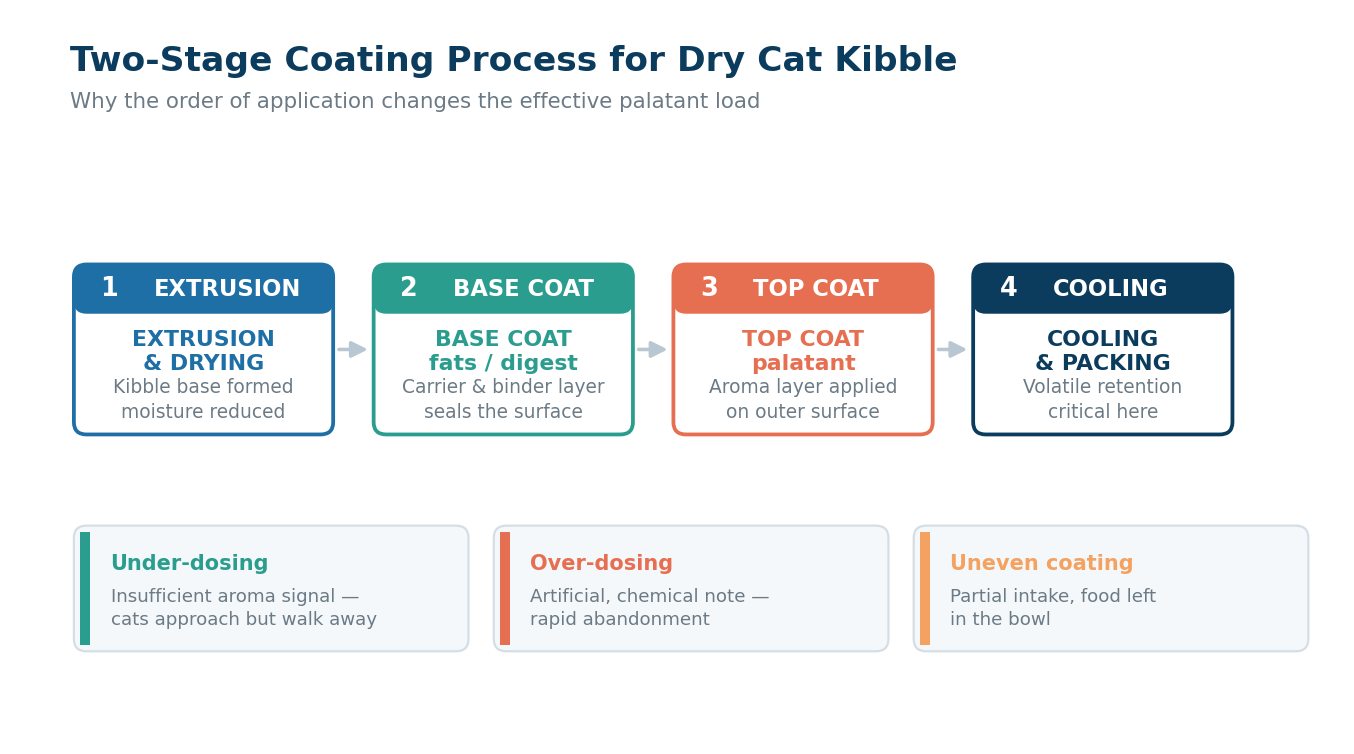
In dry cat food, palatant is typically sprayed onto kibble after drying, usually in combination with a fat or digest coating that acts as a carrier and binder. The sequence matters: a fat layer applied first can seal the kibble surface and reduce palatant absorption, while palatant applied before the fat layer may be partially washed off. Many manufacturers use a two-stage coating — a digest or fat base coat, then a palatant top coat — and the inclusion rate quoted for each stage must be understood separately.
Because palatant sits on the surface, dry kibble is vulnerable to aroma loss during storage and transport. Elevated temperature accelerates volatile loss, which is why a formulation that performs well in a plant trial can underperform after three months in a warm warehouse. Storage stability testing at realistic temperature and humidity is not optional.
In wet cat food, palatant is dispersed through the gravy, jelly or emulsion rather than coated on the outside. The animal encounters the aroma at the moment the pack is opened, and the entire matrix is consumed together. This makes wet food highly responsive to small palatant adjustments — a 0.2 percentage point change can shift acceptance measurably — but it also means over-addition quickly produces an artificial, chemical note that cats reject.
Retort conditions also matter. Sterilisation temperatures degrade a portion of heat-labile aroma compounds, so the palatant system for wet food should be selected for thermal stability rather than for maximum potency in its raw state.
Acceptance trials will tell you the answer directly, but the symptoms below usually point to a specific direction of error before the trial data is even analysed.
Symptom | Likely Cause | Direction to Move |
|---|---|---|
Cats approach the bowl but walk away | Insufficient aroma signal at first sniff | Increase top-coat rate in small increments |
Strong initial interest, rapid abandonment | Aroma promises more than the base delivers | Rebalance aroma vs. taste components |
Consistent partial intake, food left behind | Coating unevenness or poor adhesion | Review coating process, not just dosage |
Acceptance drops after several weeks | Volatile loss during storage | Select more stable palatant, adjust packaging |
Artificial or chemical odour reported | Over-inclusion | Reduce rate, re-benchmark against control |
Performance varies batch to batch | Dosing accuracy or palatant lot variation | Audit dosing equipment and supplier consistency |
The most common mistake is treating a refusal problem as a dosage problem. If cats reject food because the base formula has an off-note, adding more palatant will not solve it — it will mask the problem at best and compound it at worst. Palatant optimises acceptance of an acceptable product; it does not rescue a defective one.
A structured trial approach reaches a defensible answer faster than incremental guesswork.
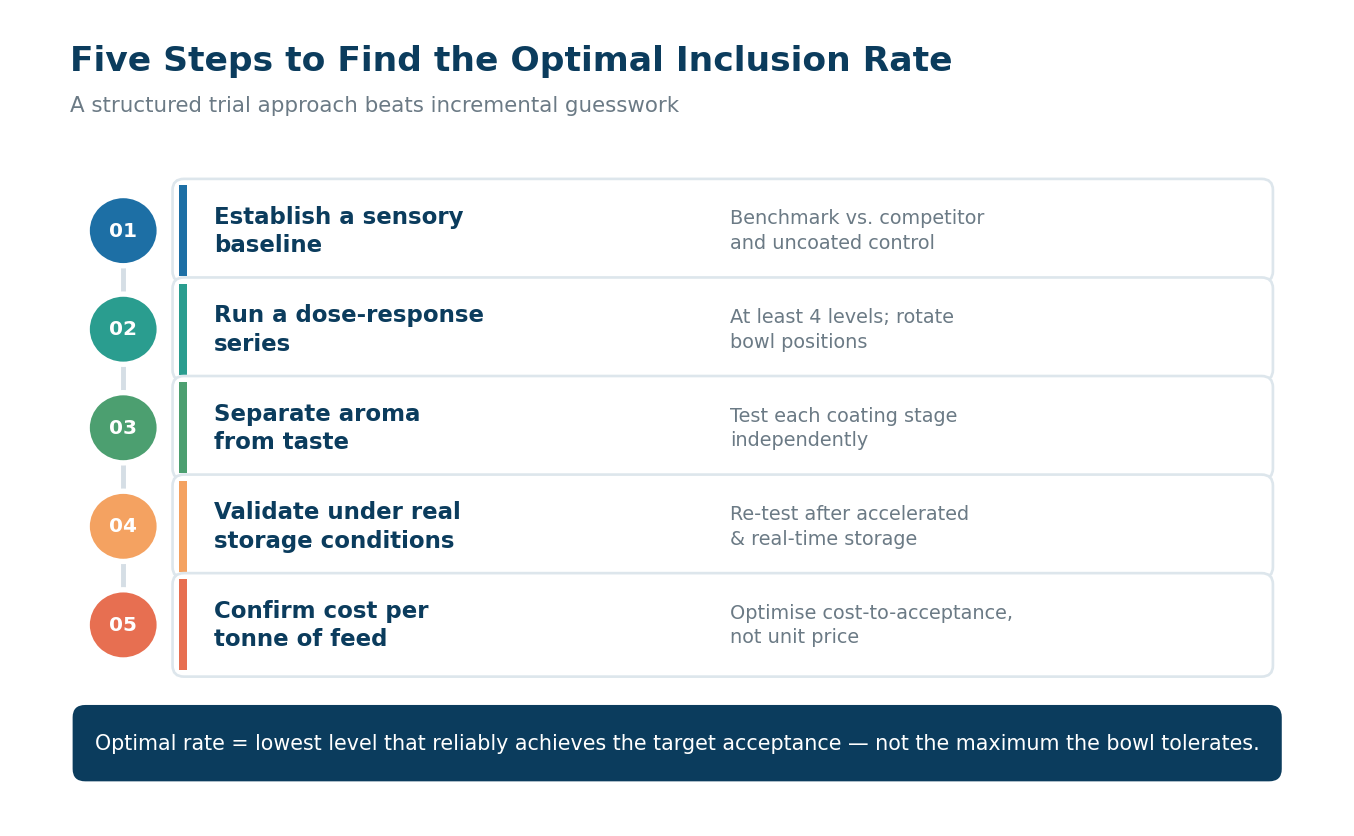
Benchmark your current product against the leading competitor in the target market, and against an uncoated control. Record first-approach time, first-bite time and total intake over a fixed window. Without a baseline, no dosage decision can be evaluated.
Test at least four inclusion levels spanning a range that brackets your hypothesis — for example 1.0%, 1.5%, 2.0% and 3.0% for a standard kibble top coat. Use a sufficient number of animals per cell to achieve statistical power, and rotate bowl positions to eliminate side bias.
Evaluate the two-stage system independently. If the top coat carries the aroma and the base coat carries the taste, changing only one at a time identifies which component is limiting acceptance.
Re-test the winning formula after accelerated and real-time storage. A dosage that wins on day one but loses after eight weeks is not the optimal rate — it is the optimal rate for a laboratory shelf.
Inclusion rate is a cost decision as much as a sensory one. A slightly higher rate of an efficient palatant frequently costs less per tonne than a lower rate of a weaker one, because what matters is the cost to achieve the target acceptance level, not the unit price of the ingredient.
Because the optimal inclusion rate is formulation-specific, the supplier's ability to support application testing matters as much as the product specification. A manufacturer with in-house palatability testing facilities, pilot-scale application capability and laboratory analysis for microbiology and antibiotic residue can shorten your development cycle significantly.
TDT BIO manufactures pet food palatants and hydrolyzed animal protein ingredients at its facility in Dezhou, Shandong, with an annual capacity exceeding 18,000 tons. Our laboratory facilities, pilot workshop and in-house palatability test base allow customers to validate inclusion rates under production-relevant conditions before committing to a full-scale run.
Most dry cat kibble uses a total palatant load between 1.5% and 4.0%, split between a liquid top coating and a powder addition. Premium and high-protein formulations often sit at the upper end of that range because the base is less inherently palatable.
No. Acceptance typically rises with dosage up to a point, then plateaus and eventually declines as over-addition introduces artificial notes. Cost also rises linearly, so the optimal rate is the lowest level that reliably achieves the target acceptance.
Wet food presents aroma in a high-moisture matrix where volatiles are more readily released, and the entire portion is consumed in one sitting. Both factors mean a lower palatant load achieves the same acceptance signal.
Uneven coating shows up as inconsistent intake within a bowl — some pieces eaten, others left — and as batch-to-batch variation in acceptance results. Reviewing the coating process, nozzle performance and dwell time usually resolves it more effectively than changing the dosage.
Yes. Palatants applied to the surface of kibble are exposed to oxidation and volatile loss. Higher inclusion rates can accelerate the development of off-notes if the fat system is not adequately stabilised, which is why storage stability testing should accompany every dosage decision.
There is no single correct palatant inclusion rate — only a correct rate for a specific formulation, process and market. Dry cat food generally operates in the 1.5–4.0% range and wet food in the 0.4–1.6% range, but those figures are starting points for trials, not specifications. The manufacturers who get this right treat inclusion rate as a tested variable supported by a sensory baseline, a dose-response series and storage validation, rather than a number inherited from the last project.
If you are reformulating a cat food product or benchmarking a competitor, our application team can support palatability testing and dosage optimisation. Get in touch with TDT BIO to discuss your formulation.
 phoebe@tdtbio.com
 +86-18972222769
 Haowangzhuang Town, Wucheng County, Dezhou City, Shandong Province, China